When planning a cross for marker-assisted selection, this question is often overlooked.Yet a simple calculation can help breeders determine whether their genotyping resources and nursery capacity are sufficient to screen enough plants to recover the desired genotype.
Here is how it works:
🎯 Step 1: Define the genetic target
Before calculating probabilities, we must clear our genetic context because genotype frequencies depend on:
• the crossing scheme (selfing vs. backcrossing)
• the generation where screening is performed
• the number of loci involved
• the loci being or no independent
For example, suppose:
• Two inbred parents are crossed
• The F₁ is selfed to produce an F₂ population
• We want plants carrying favorable alleles at 3 independent loci
If we require homozygous favorable genotypes, segregation in F₂ is:
AA : Aa : aa = 1 : 2 : 1
The probability of obtaining a homozygous favorable genotype (AA) at one locus is:
P = 1/4
For 3 independent loci:
P(desired genotype) = (1/4)³ = 1/64
So the probability that one F₂ plant has the full genotype is:
p = 1/64 = 0.0156
🎯 Step 2: Calculate how many plants must be screened
To be 95% confident of recovering at least one desired individual, the population size can be estimated using the formula:
N = ln(1 − 0.95) / ln(1 − p)
With p = 1/64:
N ≈ 190
👉 About 190 F₂ plants must be screened to have a 95% probability of recovering one individual homozygous for the favorable allele at the three loci.
📌 Practical note:
In real breeding programs, some data points are usually lost due to sampling errors, DNA extraction issues, or PCR failures.
For this reason, it is advisable to add about 10% more plants to the calculated number to compensate for potential genotyping losses.
💡 A practical shortcut: selecting carriers
In many breeding programs, it is not necessary to select fully homozygous individuals in the F₂ generation.
If heterozygous plants carrying the favorable allele are also accepted, these genotypes occur more frequently than homozygous ones. As a result, the probability of recovering the desired allele combination increases and the number of plants that must be screened can be substantially reduced.
🚀 Before starting a marker-assisted selection strategy, ask:
• How many loci am I pyramiding?
• Do I need homozygous individuals or just allele carriers (heterozygotes)?
• What is the probability of recovering the genotype?
• Does my nursery and genotyping capacity match this probability?
👉 If you’d like to be informed about the upcoming workshops organized by AgroSynapsis, and receive early access and discounts, 𝗳𝗶𝗹𝗹 𝗼𝘂𝘁 𝗼𝘂𝗿 𝘀𝗵𝗼𝗿𝘁 𝘁𝗿𝗮𝗶𝗻𝗶𝗻𝗴 𝗶𝗻𝘁𝗲𝗿𝗲𝘀𝘁 𝗳𝗼𝗿𝗺 here:
https://lnkd.in/g3tApqPz
BLOG ON MOLECULAR BREEDING
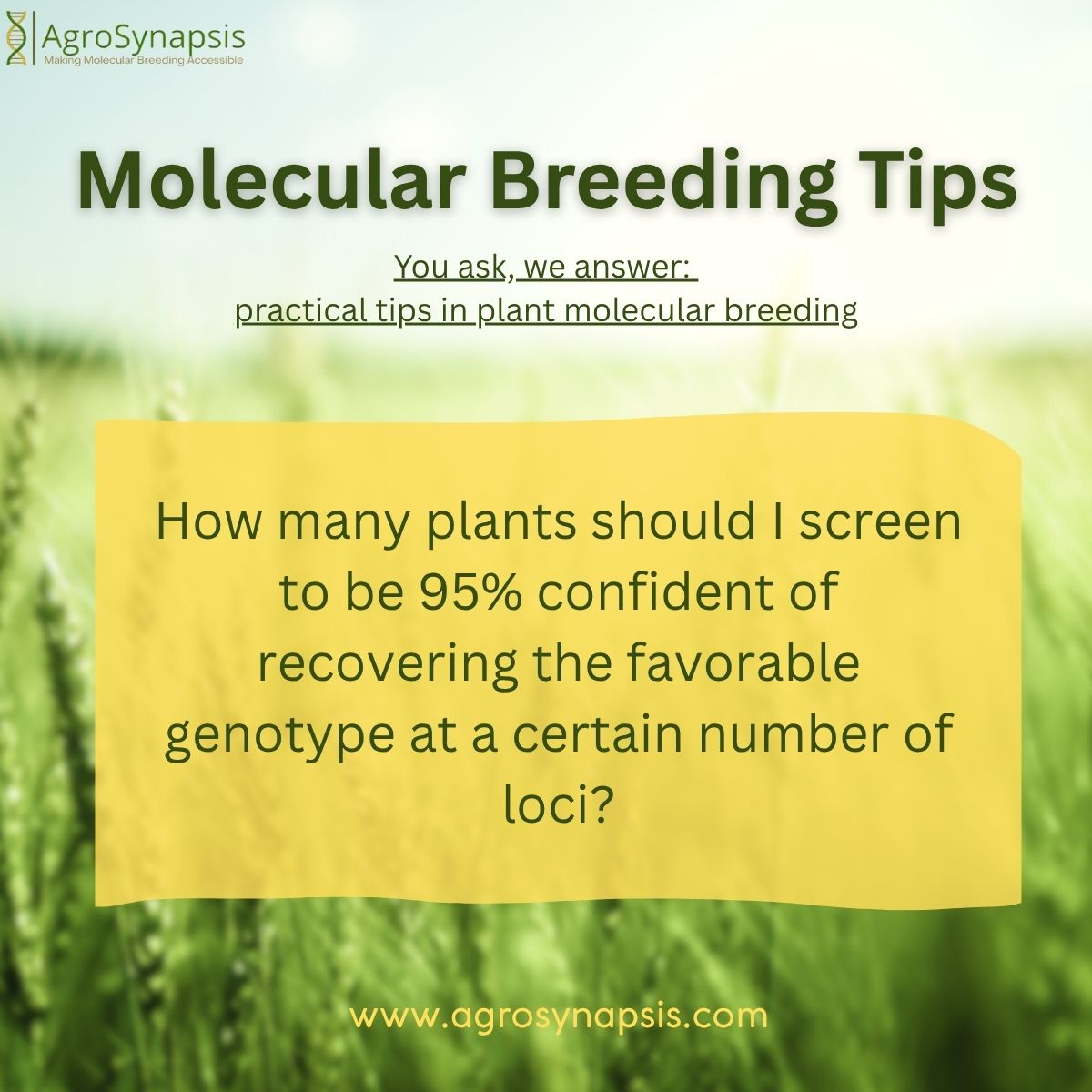
How many individuals should I screen to be 95% confident of recovering the favorable genotype at a certain number of loci?
Discover how to calculate the number of plants needed to recover target genotypes in marker-assisted selection, and align your breeding strategy with available resources.

 Estimación de la Heredabilidad - Mide con precisión qué proporción de la variación de un trait es genética, lo que guía a los mejoradores a centrarse en traits con mayor potencial de ganancia genética.