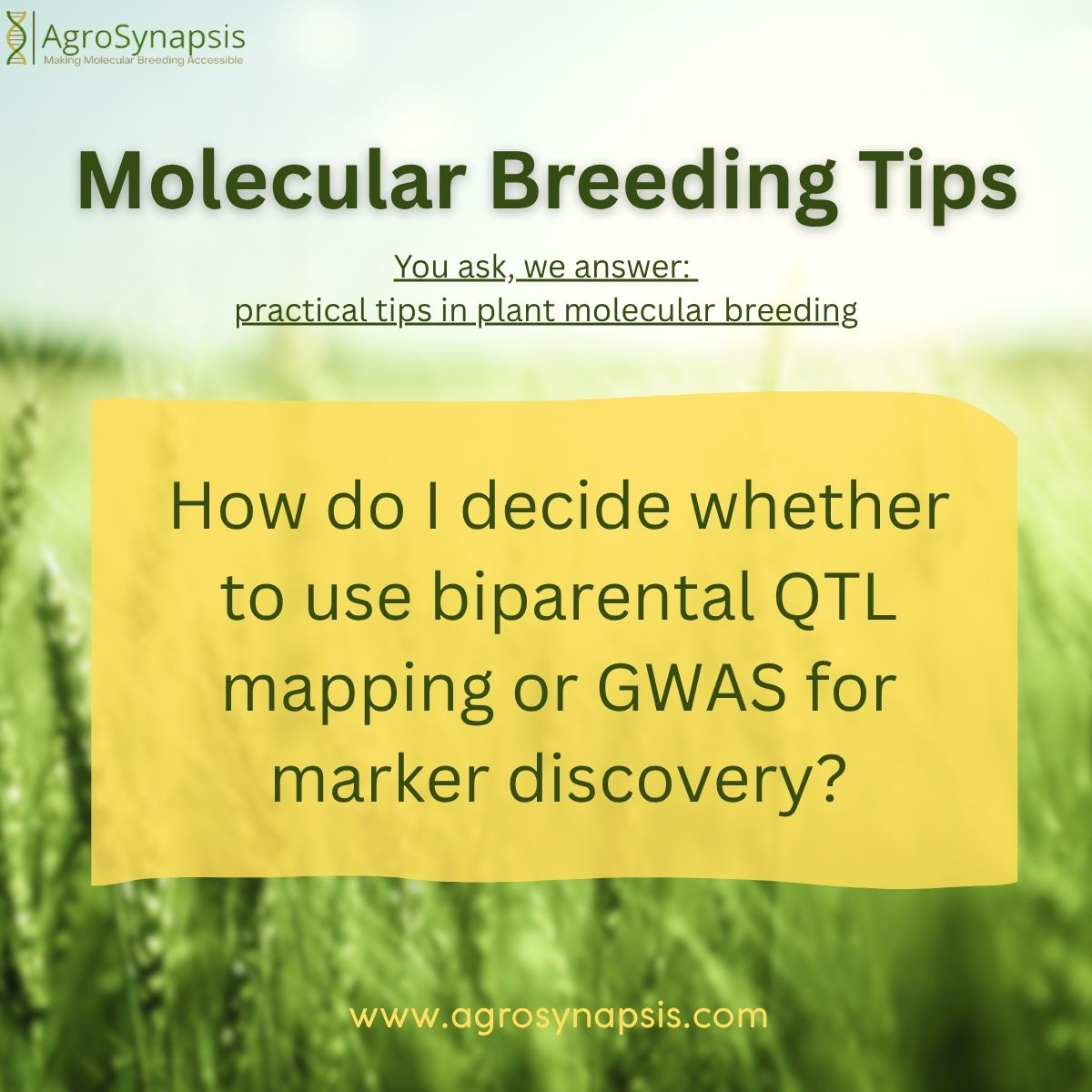
I received this question from someone in the audience during my lecture at the Department of Crop Science of the Agricultural University of Athens on February 17.
Since I like to address real questions coming from real breeding and research projects, here’s a step-by-step way to choose the right approach 👇
𝐒𝐭𝐞𝐩 𝟏: Define your breeding goal
Ask yourself:
🔹 Do I want to rapidly develop a robust, diagnostic marker for selection within a specific breeding program?
→ Biparental QTL mapping
🔹 Or do I want to understand the genetic architecture of a trait at the species level?
→ GWAS
𝐒𝐭𝐞𝐩 𝟐: Look at the genetic structure of the trait
✅ Choose biparental QTL mapping if:
– The trait is controlled by a rare gene
(e.g. a disease resistance coming from a unique wild accession)
– The trait segregates clearly between two parents
– You aim to build a Marker-Assisted Selection (MAS) tool for a specific breeding program
👉 QTL mapping offers high detection power, low noise, and fast, clear interpretation.
𝐒𝐭𝐞𝐩 𝟑: Assess your genomic and genotypic resources
✅ Choose biparental QTL mapping if:
– You are working with a new or orphan species
– A high-quality reference genome is missing
– There is limited access to high-throughput genotyping
👉 Controlled crosses can work very well with a moderate number of markers, provided they homogeneously cover the genome.
𝐒𝐭𝐞𝐩 𝟒: Consider population size & diversity
✅ Choose GWAS if:
– You have access to diverse germplasm (e.g. from a gene bank) or a pool of elite breeding liness
– You are studying a complex trait
(e.g. yield, stress tolerance, fruit quality such as Brix in tomato)
– You want to capture multiple alleles across the species
👉 GWAS leverages historical recombination and broader genetic diversity.
𝐒𝐭𝐞𝐩 𝟓: Think ahead to Genomic Selection
✅ Choose GWAS if:
– You are developing or training Genomic Selection (GS) models
– You need genotype–phenotype relationships across many genetic backgrounds
👉 GWAS is often part of the GS data ecosystem, rather than a standalone goal.
Final takeaway
When genotyping resources are limited and the favorable genotype is confined to one or very few lines, biparental QTL mapping provides a straightforward and powerful approach for rapid marker discovery.
👉 If you’d like to be informed about the upcoming workshops organized by AgroSynapsis, and receive early access and discounts, 𝗳𝗶𝗹𝗹 𝗼𝘂𝘁 𝗼𝘂𝗿 𝘀𝗵𝗼𝗿𝘁 𝘁𝗿𝗮𝗶𝗻𝗶𝗻𝗴 𝗶𝗻𝘁𝗲𝗿𝗲𝘀𝘁 𝗳𝗼𝗿𝗺 here:
https://lnkd.in/g3tApqPz
BLOG ON MOLECULAR BREEDING
How do I decide whether to use biparental QTL mapping or GWAS for marker discovery?
Discover how to choose between QTL mapping and GWAS based on your breeding goals, trait genetics, and available resources.


 Estimación de la Heredabilidad - Mide con precisión qué proporción de la variación de un trait es genética, lo que guía a los mejoradores a centrarse en traits con mayor potencial de ganancia genética.