
Redundant Markers in Genetic Mapping: Why Removing Them Improves QTL Analysis
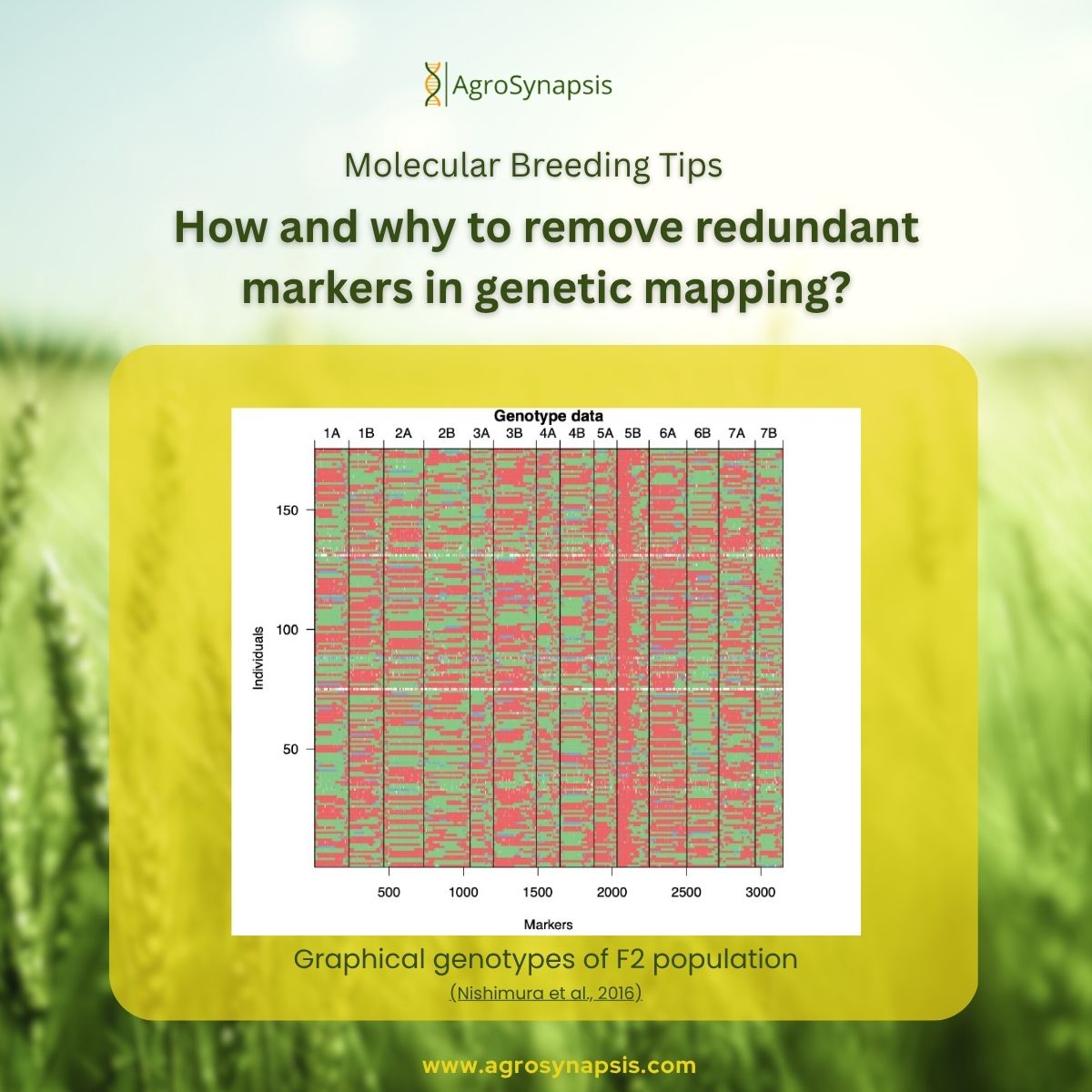
In genetic mapping and QTL analysis, high-density SNP and GBS datasets often contain many redundant markers. These co-segregating markers provide identical genetic information because no recombination separates them in the mapping population. Therefore, breeders and geneticists need to identify and remove redundant markers to build cleaner linkage maps, improve computational efficiency, and simplify QTL mapping analyses. The graphical genotype below clearly illustrates this phenomenon in an F2 population.
What Does a Graphical Genotype Reveal?
The figure immediately reveals that large chromosome segments remain completely unrecombined. Instead of observing frequent switching between parental alleles, we see long continuous chromosomal blocks inherited intact from one parent or the other. These unrecombined regions appear because only a limited number of recombination events occur during the development of biparental populations.
As a result, this pattern has major implications for genetic mapping and linkage map construction. Many nearby SNP markers fall into exactly the same recombination position and consequently provide identical genetic information. Geneticists commonly refer to these groups of co-segregating markers as “bins.”
What Is a Marker Bin?
A marker bin represents a chromosome region where the mapping population shows no recombination event among several markers. Since all markers inside that region segregate identically, researchers cannot genetically distinguish them from one another. In practical terms, hundreds of SNP markers may collapse into a single informative recombination bin.
Therefore, marker quantity does not necessarily mean mapping quality. Modern SNP arrays and genotyping-by-sequencing (GBS) technologies can generate thousands of markers at low cost. However, the number of recombination events in biparental populations remains biologically limited. As a consequence, many markers become redundant.
Why Recombination Frequency Creates Redundant Markers
Marker redundancy becomes even more pronounced around centromeric regions, where recombination frequency drops dramatically. In these chromosome regions, very large physical distances may correspond to only very small genetic distances. Because recombination rarely occurs there, large parental haplotype blocks remain intact across generations.
As a result:
- many nearby markers co-segregate
- recombination bins become very large
- linkage maps become overcrowded with redundant information
Thus, this biological phenomenon explains why high-density SNP datasets often contain far more markers than truly informative recombination events.
Problems Caused by Redundant Markers in Genetic Mapping
Keeping all redundant markers in a linkage map rarely improves QTL detection or mapping resolution. Instead, excessive marker redundancy creates several practical drawbacks:
- It increases computational time and memory usage
- It slows QTL analyses and permutation tests
- It overcrowds linkage maps and makes them difficult to visualize
- It complicates the interpretation of genetic results
- It does not add mapping resolution despite the higher marker density
For this reason, researchers should remove redundant markers as an essential preprocessing step in modern genetic mapping workflows.
How QTL IciMapping Removes Co-Segregating Markers
Software such as QTL IciMapping can automatically identify co-segregating markers and retain representative markers for map construction and QTL analysis. By simplifying the dataset, researchers obtain linkage maps that are:
- cleaner
- faster to analyze
- easier to visualize
- biologically more interpretable
In this way, removing redundant markers improves computational efficiency without substantially reducing the genetic information available for initial QTL detection.
Learn QTL Mapping with QTL IciMapping
Interested in applying these concepts in real datasets? AgroSynapsis is launching a fully hands-on eWorkshop on QTL Mapping with QTL IciMapping. The course focuses on practical linkage map construction, marker preprocessing, graphical genotyping, QTL detection, and interpretation of mapping results in biparental populations.
The workshop is designed for breeders, researchers, and students who want to implement QTL analysis in practical breeding programs.
Learm more about the workshop.
When Redundant Markers Become Useful Again
However, redundant markers do not always represent useless data. During fine mapping, breeders can generate additional recombination events in a target genomic region. Then, previously redundant markers may become highly informative.
In these situations, high-density marker datasets become extremely valuable because they help researchers:
- dissect smaller chromosomal intervals
- increase mapping resolution
- identify candidate genes
- develop tightly linked molecular markers
Therefore, the optimal marker strategy depends on the biological objective:
For initial QTL detection:
→ simplify the map and remove redundancy
For fine mapping and candidate gene discovery:
→ exploit high-density marker information
Frequently Asked Questions
What are redundant markers in genetic mapping?
Redundant markers are co-segregating markers that show identical inheritance patterns because no recombination event separates them in the mapping population.
What is a marker bin?
A marker bin is a chromosome region where multiple markers share exactly the same recombination position.
Why should redundant markers be removed?
Removing redundant markers simplifies linkage maps, improves computational efficiency, and facilitates QTL interpretation without significantly reducing mapping power.
Does removing redundant markers reduce mapping quality?
Generally, no. Since co-segregating markers provide identical information, removing redundant markers usually does not reduce QTL detection efficiency.
Practical References and Resources
In addition to the concepts discussed above, the following resources provide further practical and scientific information on QTL mapping, recombination frequency, marker redundancy, and linkage map construction. Moreover, these references may help breeders, researchers, and students better understand how recombination patterns influence marker behavior in biparental populations and how software tools can simplify genetic mapping workflows.
QTL IciMapping software
– official software for linkage map construction, marker bin analysis, and QTL detection.
Recombination suppression around centromeric regions
– research article explaining how low recombination frequency contributes to large unrecombined chromosome segments and marker redundancy.
Introduction to QTL Mapping
– educational overview describing the principles and applications of quantitative trait loci analysis.
Conclusion
Removing redundant markers is a fundamental step in modern genetic mapping and QTL analysis. By identifying co-segregating markers and simplifying linkage maps, breeders and geneticists improve computational efficiency, map interpretation, and downstream QTL detection.
At the same time, high-density marker datasets remain essential for fine mapping and candidate gene discovery when breeders introduce additional recombination events. In genetic mapping, efficiency is not about keeping every marker. It is about keeping the markers that add information.



 Heritability Estimation – we accurately measures how much of a trait’s variation is genetic, guiding breeders in focusing on traits with higher genetic gain potential.